Case Study — In-Vehicle UX · Proof of Concept
Honda × Parkopedia
POC for reserving and payment for a parking space through CarPlay and Android Auto.

POC for reserving and payment for a parking space through CarPlay and Android Auto.
I led the flow architecture, in-vehicle interface design, and interactive prototype for this proof of concept with Honda R&D Innovations.
The result was a working POC that clarified the full problem and gave the team a concrete path forward, not just the happy path.
Team, tools & scope
Honda's in-house team had designed the happy path for a car approaching its destination, but it didn't cover the full journey.
It missed steps like getting into the car, sitting in place, and driving to the destination. It didn't include direct user validation, since Honda's team handles that.
Honda was deciding if in-vehicle parking payment was viable, if Parkopedia was the right partner, and if payment inside a moving vehicle was more of a safety issue than a UX issue. I identified pain points based on the driving context instead of confirming them with drivers.
Why it had stalled
The research focused on technical discovery. I used a design audit, competitive review, review of automotive app design principles, and technical investigation.
The audit compared Honda's work to all driving states. The competitive review showed that most systems and parking apps assume the user is stationary and holding a phone. I also went through the driving-to-parking process myself and documented each step.
I reviewed the prototype with Honda and Parkopedia stakeholders and TribalScale engineers, while the in-house Honda team took over user testing.
Key findings

I reviewed Honda's existing designs and identified what was missing. I divided the experience into three driving states: moving, approaching the parking spot, and stopped. Honda's happy path covered the approaching state, so I designed the other two. While moving, the system uses voice-driven confirmation, and when stopped, it allows touch-driven search and payment.
I led the payment-security discovery and confirmed that Parkopedia's system needed to handle payment. This set the constraint early, before it could affect the design, and clarified the integration path for the team.
I built an interactive prototype to show what was possible. TribalScale engineers used it to create a proof of concept for Honda in Android Auto, helping move the concept from design into implementation.
I designed a complete in-vehicle parking concept for three driving states, with payment handled by Parkopedia's system.
While driving, the interface highlights key actions, uses short sentences, and reads instructions aloud. It suggests nearby lots and accepts voice confirmation, without map use or payment entry. When parked, it allows map search, price and ETA comparison, and touch-confirmed payment. The third state, approaching the parking spot, builds on Honda's original happy path. These three states together cover the full journey: driving, choosing where to park, and parking.
I simplified the screen to show only what matters for decisions: price, ETA, and a garage or street toggle. If drivers read more, they might not watch the road. I also designed the error states instead of leaving them for later.
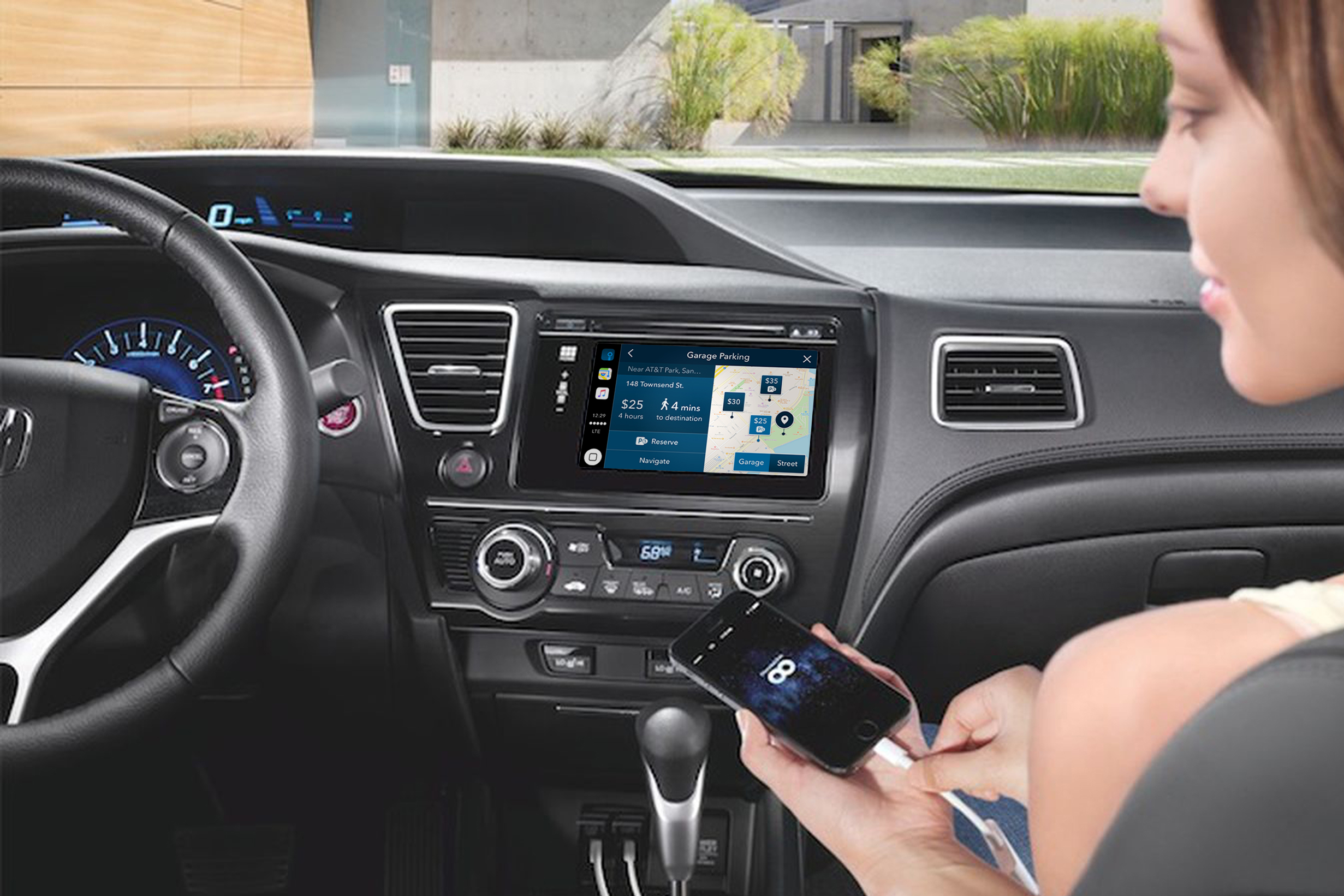
TribalScale engineers used my prototype to build a proof of concept for Honda in Android Auto.
I created the in-motion and error-state flows, which were new and essential to the build. After in-house user testing, the POC was handed over to MXNavi, a tech company in China, for further development. Since the 2021 launch, the app has approximately 3 million users.
What came after
What worked
Reviewing Honda's in-house designs and pointing out what was missing shifted the project from execution to problem definition, clarifying the business need. I helped set the scope and work through edge cases and integration scenarios with the product and engineering teams, strengthening the foundation for the build.
What I'd do differently
The POC was tested internally at Honda’s headquarters. I suggested using cameras in the front and back seats to track eye movement and see what users focus on, along with voice narration.
What I learned
Context limits a design more than any brand or platform rule. By designing for the toughest situations, this concept worked well with engineering and strengthened the overall solution.