Case Study — Cross-Functional Research & Experience Strategy
Deciem
Persona building, product strategy and omnichannel experimentation.

Persona building, product strategy and omnichannel experimentation.
Deciem hired me as their first Lead Researcher and UX Strategist.
I led all research activities, defined the strategy, owned participant recruitment, and created a feature prioritization framework based on customer feedback. I also directed the initial regimen builder experience and design on theordinary.com.
Team, tools & scope
Customer service teams regularly interacted with direct customer feedback, while marketing and design teams had less exposure to these insights.
Deciem expanded quickly across brands and focused on product education and sustainability. Teams tackled different problems without a unified vision.
94% of the customer service team’s contacts were for product guidance customers couldn’t find on their own.
Challenges
Internal interviews uncovered conflicting priorities across all five departments, while external research targeted key drop-off points in user analytics.
I conducted 1:1 departmental interviews alongside 60-minute user sessions—split evenly between qualitative feedback on shopping and sustainability, and usability testing to investigate a 46% bounce rate across participants aged 24–64.
What the research revealed
Unpack siloed perspectives. Facilitated 1:1 stakeholder interviews across all five departments to uncover underlying misalignments without the power dynamics of joint sessions.
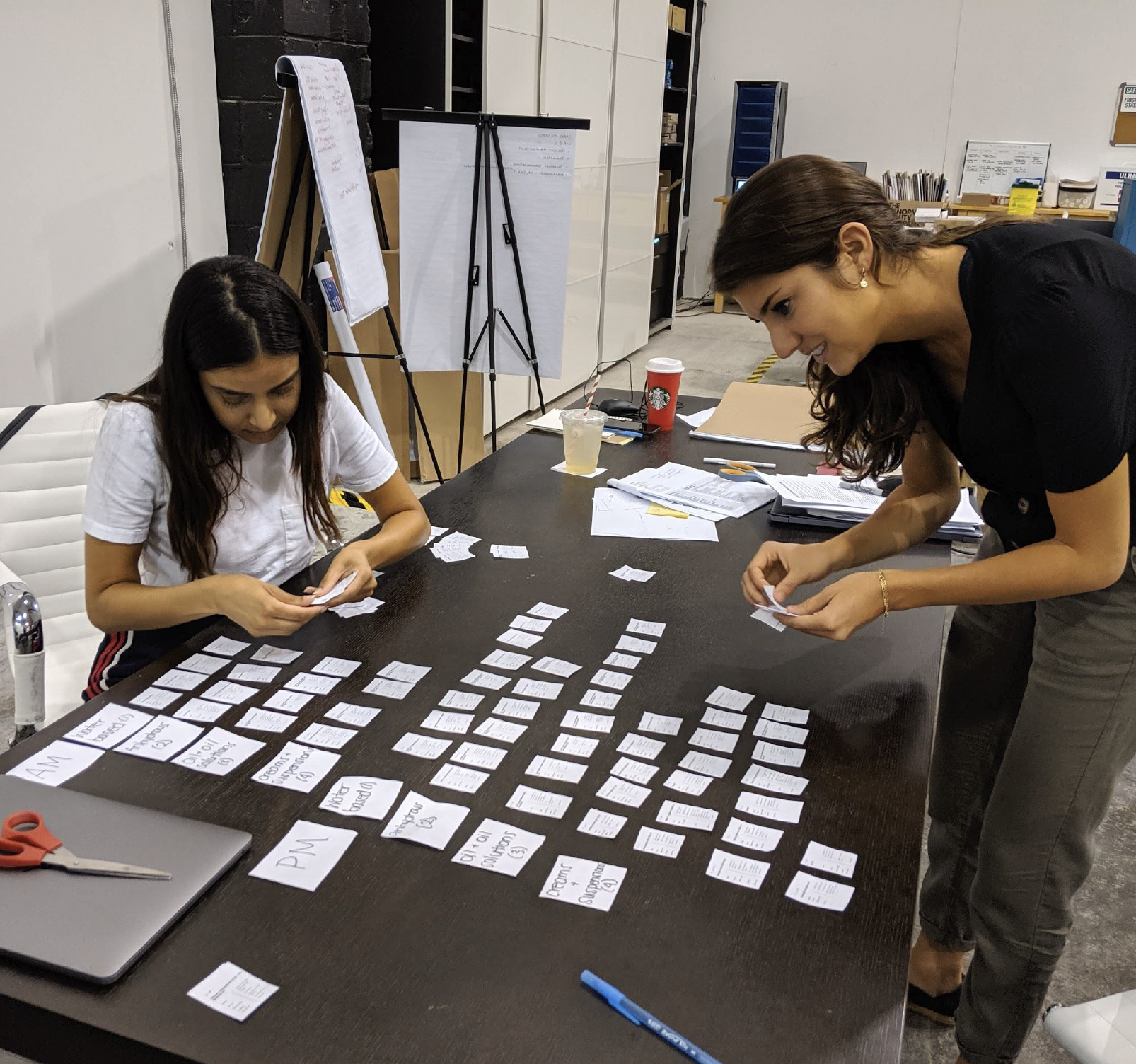
Build consensus through data. Ran live card-sorting workshops mapping conflicting internal priorities (e.g., marketing visibility vs. customer clarity) directly against user pain points to drive cross-functional alignment.
Target high-friction touchpoints. Analyzed drop-off analytics to isolate failing screens, structuring usability testing scripts strictly around proven friction areas.
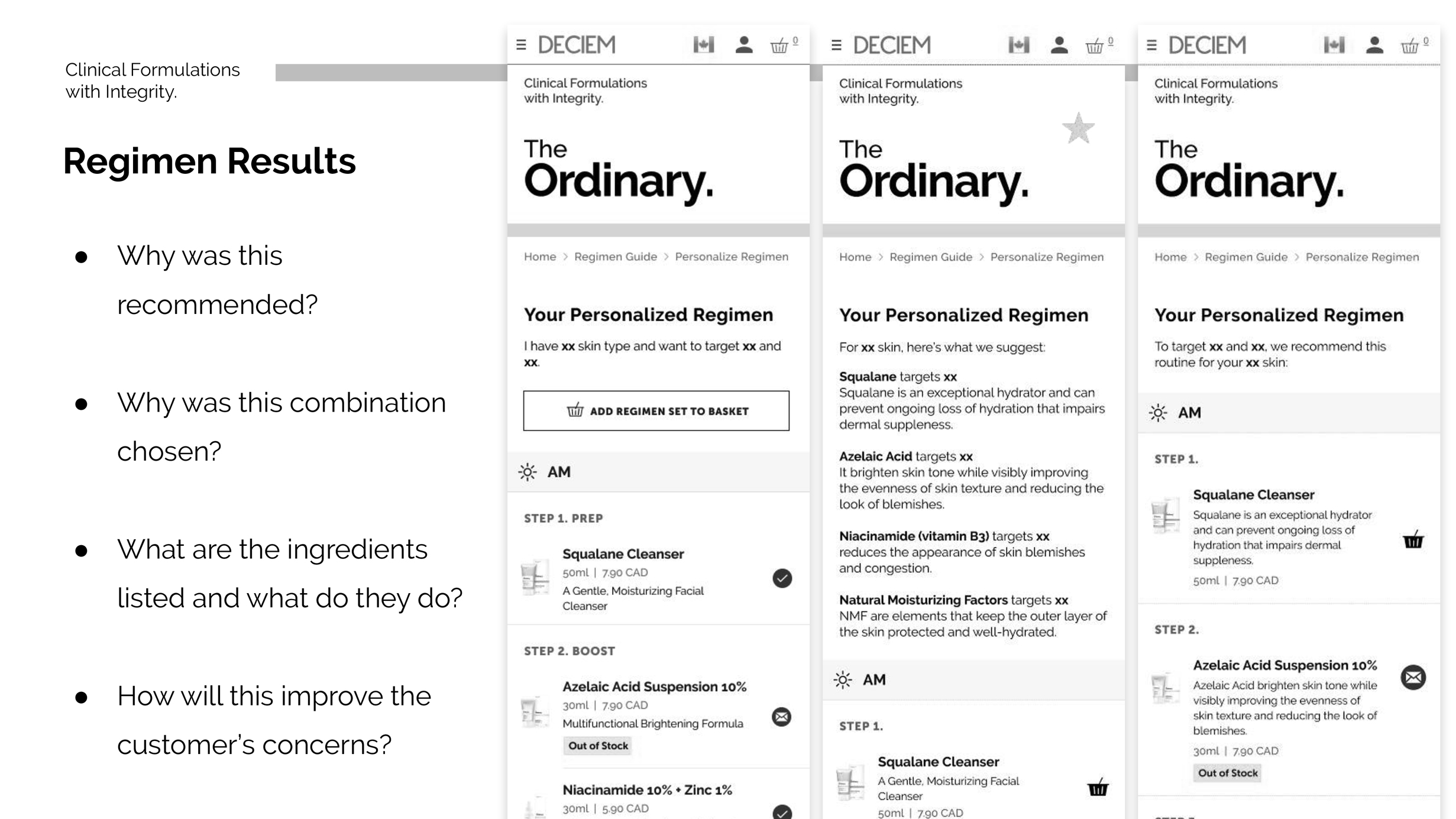
Test complex concept framing Evaluated three regimen-page variants (skin type, ingredient function, routine) to determine the most intuitive mental model for non-expert users.
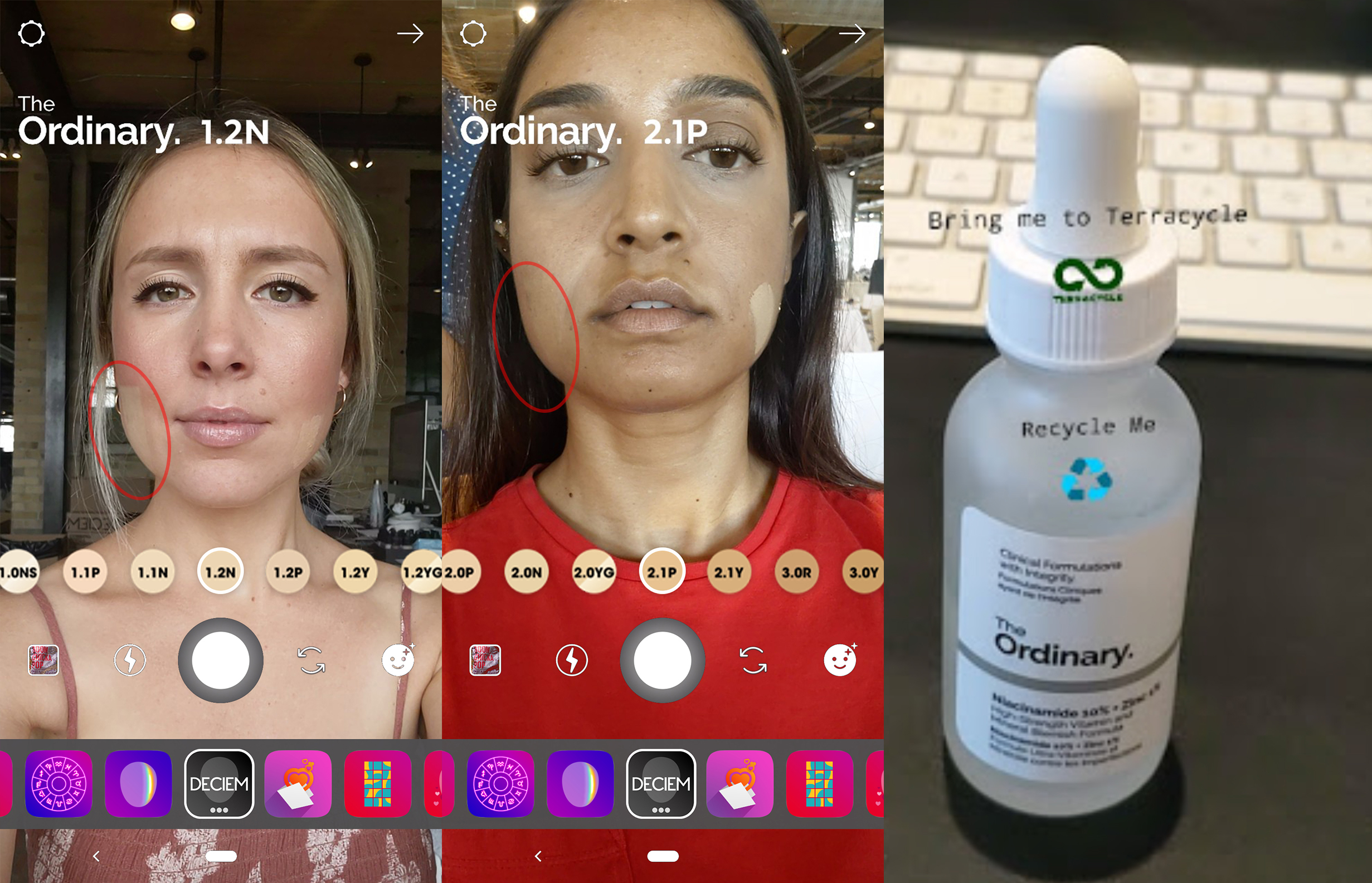
Scaling education through Augmented Reality Prototyped two Spark AR experiences: a shade-matching tool calibrated alongside customer-support experts and a recycling filter bringing the in-store TerraCycle program to digital.
The project resulted in a unified, cross-departmental understanding of both brand positioning and customer needs, leading to greater organizational alignment.
A clear roadmap was developed that distinguished immediate, actionable improvements from broader, long-term initiatives. Additionally, two augmented reality concepts were introduced to support education and sustainability efforts beyond traditional retail settings.
Why Spark AR. The platform choice was the strategy — Deciem's customers already uses Instagram to discover new products, which removed the acquisition step a standalone app or a new site section would have required.
Design system elements. The regimen page testing produced a component library that the internal team continues to use on theordinary.com today.
What was delivered
By aligning five departments around a single view of customer need, I translated an undifferentiated backlog into an actionable, two-tier roadmap for leadership.
Business outcome. The research, feature requirements, and prioritization I delivered directly guided the launch of the personalized regimen builder on theordinary.com, serving as key inputs toward Deciem’s targets to increase conversion and reduce bounce rates.
While two Spark AR concepts were intentionally held at the prototype stage due to shifting business priorities and technical feasibility constraints, this strategic trade-off ensured immediate focus stayed on shipping core web improvements, which is a solution that is more accessible to the larger population of the world.
What shipped, what didn't
What worked
Making the research undeniable rather than persuasive. Facilitating live card sorting empowered teams to co-create the priority list, while raw interview clips eliminated debate over interpretation and grounded decisions directly in user evidence.
What I'd do differently
Define a dedicated attribution framework with stakeholders on day one rather than relying on broad, company-wide metrics post-launch. I would also expand user recruitment beyond a single market to capture broader geographic and demographic nuances earlier in discovery.
What I learned
The core friction in most organizations is rarely a lack of customer insight—it is that critical insight lives with front-line teams who have the least authority to act on it.